

What is DRP? How to plan distribution
What DRP is, how to calculate it step-by-step with an example, how it differs from MRP, and the benefits it brings to a distribution network.
A company can have all the total stock it needs and still run out of product where the customer asks for it. This happens when one distribution center accumulates surpluses while another faces stockouts, or when replenishment decisions are made warehouse by warehouse, looking only at what was sold the previous week.
DRP solves that problem: it plans how much to send, from where, and when, so that every point in the network has just the right inventory at the moment it is needed. This article explains what DRP is, how to calculate it step-by-step, how it differs from MRP, and how it is applied today using artificial intelligence.
What is DRP?
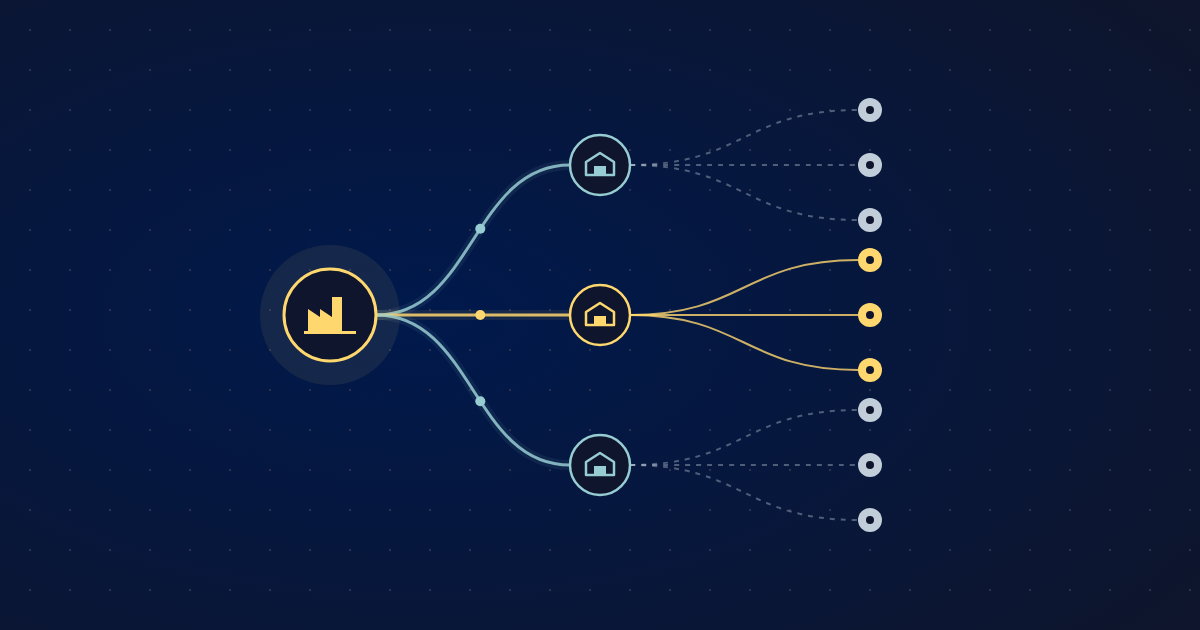
DRP (Distribution Requirements Planning) is a method for planning the replenishment of finished goods throughout a distribution network: plants, distribution centers, regional warehouses, and, in some cases, points of sale.
It starts with the demand forecast for each point in the network and, using available stock, orders in transit, safety stock, and lead times, it calculates the quantity to be sent to each location and on what date. The result is a shipping plan that, when aggregated from the bottom up, also tells the plant how much it needs to produce or dispatch.
It is sometimes called Distribution Resource Planning (DRP II) when, in addition to quantities, it plans logistical resources: trucks, storage capacity, and personnel.
How DRP works step-by-step
The calculation is performed for each product at each point in the network, period by period (generally, weeks):
- Demand forecast: how much is expected to be sold or dispatched from that point each week.
- Available and in-transit stock: current inventory plus what is already on the way.
- Projected stock: previous week's stock + incoming shipments − the week's demand.
- Net requirement: if the projected stock falls below the safety stock, replenishment is necessary.
- Planned shipment: the quantity to be replenished, rounded to the shipping lot size (a truckload, a full pallet).
- Departure date: shipments are released as many weeks in advance as the lead time requires.
- Consolidation: shipments from all centers are aggregated to form the total demand that must be met by the supplying plant or center.
Calculation example
A distribution center has an initial stock of 500 units, a safety stock of 150, a lead time of one week, and ships in batches of 400 units.
- Week 1: demand of 200, leaving 300 in stock. A shipment of 400 is sent to arrive in week 2.
- Week 2: demand of 250. Without replenishment, stock would drop to 50, so the 400 units arrive, bringing the total to 450.
- Week 3: demand of 300, leaving 150 in stock, exactly at the safety stock level. A shipment of 400 is sent.
- Week 4: demand of 250. 400 arrive and stock is at 300. Another shipment of 400 is sent.
- Week 5: demand of 200. 400 arrive and stock is at 500.
The key is that each shipment is sent one week before it is needed, as that is the time it takes to arrive. This way, stock never falls below the safety minimum.
DRP vs. MRP: what is the difference?
They use the same calculation logic but look at opposite sides of the supply chain. DRP looks toward the customer, while MRP looks toward the suppliers.
- What it plans: DRP plans the replenishment of finished products; MRP plans the purchasing of raw materials and components.
- Where: DRP, in distribution centers and warehouses; MRP, in production plants.
- Based on: DRP, on the demand forecast for each point in the network; MRP, on the master production schedule (MPS).
- Result: DRP, a shipping plan between network points; MRP, purchase and manufacturing orders.
The two are connected: the sum of the shipments calculated by the DRP feeds the master production schedule, which then determines what the MRP needs to purchase. Without a DRP, the plant produces against an aggregate forecast that does not reflect where each product is needed.
Benefits of DRP
- Fewer stockouts: each center receives product before falling below its safety stock levels.
- Lower total inventory: stock is placed where it will be sold, rather than accumulating "just in case" in every warehouse.
- Fewer emergency shipments: by seeing needs weeks in advance, you avoid emergency transfers between centers, which are the most expensive.
- Better transport utilization: shipments are planned in full loads and can be consolidated by route.
- A plant that produces what the network needs: the demand received by the plant is already broken down by destination and date.
Which industries use it?
DRP is key for any company that distributes through multiple centers or warehouses:
- Consumer goods and food & beverage: many SKUs, high turnover, and perishable products.
- Pharmaceuticals and cosmetics: extensive networks and high service level requirements.
- Retail: replenishment from distribution centers to hundreds of stores.
- Industrial distribution and auto parts: extensive catalogs with irregular demand.
AI-powered DRP
Traditional DRP relies on three data points that often fail: a monthly forecast that arrives late, fixed safety stocks that no one reviews, and lead times that vary in practice. Artificial intelligence improves all three:
- More precise forecasting: combines demand planning with demand sensing, which adjusts short-term demand based on recent signals like orders and sell-out data.
- Dynamic safety stock: recalculated based on the actual variability of demand and lead times for each product at every location.
- Scenario planning before deciding: allows you to compare, for example, what happens if a warehouse closes, a supplier is delayed, or a promotion is launched, and see the impact on service, inventory, and cost.
The Nestlé Brazil case
Nestlé Brazil plans for over 1,350 SKUs across its distribution centers. With Pyplan, they moved to a digital workflow that integrates DRP, demand sensing, and automation, improving forecast accuracy across all their distribution centers, along with planning agility and product availability. Read the Nestlé case study.
DRP FAQs
What does DRP stand for? Distribution Requirements Planning. It is the method used to calculate how much product to send to each point in the distribution network and when.
How often is DRP run? Generally, once a week, with a horizon of 8 to 26 weeks. Companies with high turnover run it daily for short-term execution.
Is DRP useful for companies with only one warehouse? Its value emerges when there are multiple levels or multiple points in the network. With a single warehouse, a good replenishment calculation and safety stock are sufficient.
Can DRP be done in Excel? With few products and few centers, yes. With hundreds of SKUs, multiple warehouses, and weekly updates, the spreadsheet becomes slow, fragile, and difficult to keep up to date with ERP data.
What is the relationship between DRP and S&OP? S&OP agrees on the demand and supply plan at an aggregate level. DRP breaks that plan down into the details for each product, each center, and each week.
Conclusion
DRP converts the demand forecast into a concrete shipping plan: which product, to which center, in what quantity, and in which week. When applied correctly, it reduces stockouts and inventory at the same time, because it places stock where it will be sold.
The difference today is made by connecting it with the rest of the planning process: a forecast that adjusts to real-time signals, safety stocks that recalculate automatically, and a production plan that responds to what the network requires.
Do you want to see how Pyplan plans distribution from end to end? Explore the DRP module →
You might also be interested

Agentic AI in planning: separating the hype from the product
The 2026 tariff volatility requires replanning in days, not months. What capabilities do Supply Chain and Finance need to avoid being exposed?

Data governance for planning with confidence
Control, traceability and consistency in each number

Modeling the business, not just the numbers
How Pyplan's influence diagrams transform complex rules into clear decisions
See Pyplan in action